What Are JA Solar Modules (and How Do They Work)?

Just so you know: if you buy something through a link on this page, we may earn a commission.
JA Solar modules are photovoltaic panels manufactured by JA Solar Technology Co., Ltd., one of the world’s largest solar cell and module producers, known for combining high efficiency ratings with competitive pricing across residential, commercial, and utility-scale applications. Since its founding in 2005, the Shanghai-based company has shipped over 200 gigawatts of solar modules globally, establishing itself as a reliable tier-one manufacturer whose products regularly appear in independent performance testing and bankability rankings.
For homeowners and business decision-makers evaluating solar investments in 2026, understanding what sets JA Solar apart matters because module choice directly impacts system performance, long-term energy yields, and project economics. JA Solar’s product lineup spans monocrystalline PERC and TOPCon technologies, with recent models achieving efficiencies above 22% while maintaining warranty terms that match or exceed industry standards. The company’s vertical integration, from silicon wafer production through final module assembly, allows tighter quality control and cost management compared to manufacturers reliant on external suppliers.
This explainer clarifies what JA Solar modules are, how their cell architecture and manufacturing processes translate to real-world performance, the distinct product series available for different project types, and practical considerations for specifying these modules in residential rooftop systems versus large ground-mount installations. Whether you’re comparing quotes from installers, assessing long-term reliability data, or determining which module technology fits your energy goals and budget, the following sections provide the technical depth and practical context needed to make an informed decision about JA Solar’s role in your solar project.
What JA Solar Modules Are

JA Solar modules are photovoltaic panels that convert sunlight into electrical energy, produced by JA Solar Technology Co., Ltd., a leading Chinese manufacturer with global reach. Founded in 2005 and headquartered in Shanghai, the company has grown into one of the world’s largest solar module suppliers, consistently ranking among the top five producers by annual shipment volume. JA Solar modules are deployed across residential rooftops, commercial buildings, and utility-scale solar farms in more than 160 countries.
The company operates multiple manufacturing facilities in China and has expanded production internationally to meet growing demand and navigate trade policies. JA Solar’s vertically integrated supply chain spans silicon ingot production through cell fabrication to finished module assembly, giving the company control over quality and cost at each stage. This scale and integration enable JA Solar to offer reliable products with consistent performance across its extensive portfolio.
What sets JA Solar apart in a crowded market is its focus on advanced cell technologies that boost efficiency without dramatically increasing price. The company was an early adopter of PERC (Passivated Emitter and Rear Cell) architecture and half-cut cell designs, innovations that have since become industry standards. JA Solar modules typically achieve efficiencies in the 20-22% range for mainstream models, with premium series pushing above 22%, positioning them competitively alongside peers like Trina Solar PV module offerings.
JA Solar’s reputation rests on delivering bankable, well-tested products backed by robust warranties and third-party certifications. The company’s modules regularly pass stringent IEC and UL testing, and its financial stability reassures project developers and lenders that performance guarantees will hold over the 25-year lifespan typical of solar installations. For homeowners and businesses evaluating module options in 2026, JA Solar represents a proven, globally recognized choice.
How JA Solar Modules Work

JA Solar modules operate through the photovoltaic effect, the same fundamental process that powers all solar panels. When sunlight strikes the module’s surface, photons from that light penetrate the protective glass layer and reach silicon solar cells arranged beneath. These cells, typically made from crystalline silicon wafers, contain semiconductor materials that generate an electric current when exposed to light. The photons knock electrons loose from silicon atoms, creating a flow of electricity that the module captures and channels through metallic conductors embedded in each cell.
Understanding how modules work requires looking at their layered construction. A JA Solar module consists of several key components working together: tempered glass on the front protects the cells from weather and impact while allowing maximum light transmission; the solar cells themselves form the active layer where conversion happens; an encapsulant material (usually EVA polymer) seals the cells between the glass and a rear protective backsheet or glass layer; an aluminum frame provides structural support and mounting points; and a junction box on the back houses electrical connections and bypass diodes that maintain performance if part of the module is shaded.
JA Solar enhances this basic architecture with targeted innovations that boost efficiency and output. Their PERC (Passivated Emitter and Rear Cell) technology adds an extra reflective layer on the back of each cell, bouncing unabsorbed light back through the silicon for a second chance at conversion. This simple modification increases efficiency by one to two percentage points compared to standard cells. Half-cut cell design takes each standard cell and physically cuts it in half, reducing electrical resistance and improving performance in partial shade conditions while lowering operating temperature. The result is more power from the same physical space.
Bifacial modules, available across several JA Solar series, capture light from both sides. The rear surface collects reflected and diffuse light bouncing off the ground or nearby surfaces, generating up to 30 percent additional energy depending on installation conditions. Multi-busbar architecture spreads current collection across more thin wires rather than a few thick ones, reducing shading losses and improving reliability. These innovations stack together, transforming absorbed sunlight into usable direct current electricity with conversion efficiencies now exceeding 22 percent in JA Solar’s premium modules, a significant leap from the 15 to 17 percent typical just a decade ago.
Types and Series of JA Solar Modules

DeepBlue Series
JA Solar’s DeepBlue series targets residential and commercial rooftops where space comes at a premium. These modules pack PERC (Passivated Emitter and Rear Cell) technology and half-cut cell designs into a standard footprint, delivering power outputs typically ranging from 360W to 450W depending on the specific model. The half-cut architecture splits each full-size cell into two smaller segments, which reduces resistive losses and improves performance under partial shading, a common scenario on residential roofs with chimneys, vents, or nearby trees.
DeepBlue modules suit homeowners who want maximum generation from a limited roof area without stepping up to premium bifacial panels. The series also appeals to commercial property owners installing on flat or low-slope rooftops, where higher efficiency per square meter translates directly to better financial returns. JA Solar integrates multi-busbar technology into DeepBlue panels, further lowering internal resistance and enhancing reliability. This combination of proven solar module technology makes the DeepBlue lineup a practical choice for space-constrained projects that demand strong output and long-term durability.
JAM Series
The JAM series represents JA Solar’s flagship offering for utility-scale solar farms and large commercial installations. Designed with monocrystalline PERC cells, these modules deliver power outputs ranging from 450W to over 600W per panel, enabling developers to maximize energy generation across expansive arrays.
JAM modules excel in reducing balance-of-system costs. Higher wattage per module means fewer panels, mounting structures, and installation labor hours needed to reach a target capacity. This efficiency directly lowers the levelized cost of energy, the metric that matters most for project economics.
Bifacial JAM modules capture reflected light from the ground, boosting energy yield by up to 25% depending on surface albedo and installation height. This feature proves especially valuable in desert installations or sites with reflective surfaces beneath the array.
The series incorporates multi-busbar technology and half-cut cell architecture, improving current flow and reducing resistive losses. These modules maintain strong performance even under partial shading or soiling conditions common in utility-scale environments. With competitive pricing and proven field reliability, JAM modules help large-scale solar projects meet aggressive cost and production targets in 2026’s competitive renewable energy market.
Specialized and Emerging Technologies
Beyond their established PERC and bifacial technologies, JA Solar has invested heavily in next-generation N-type silicon cell architectures that push efficiency boundaries further. N-type cells use phosphorus-doped silicon instead of the boron-doped P-type silicon found in conventional modules, resulting in lower light-induced degradation and better performance over the module’s lifetime.
JA Solar’s TOPCon (Tunnel Oxide Passivated Contact) technology represents their flagship N-type platform as of 2026. TOPCon modules achieve conversion efficiencies exceeding 22% in commercial production by adding an ultra-thin oxide layer and a doped polysilicon layer to the rear of the cell, which reduces electron recombination losses. This architecture delivers higher power output per square meter while maintaining the durability advantages of N-type silicon.
The company has also explored back-contact cell designs and heterojunction technology in research settings, though these remain less prominent in their commercial lineup compared to TOPCon. These emerging architectures focus on eliminating front-surface shading from metal contacts and stacking different semiconductor materials to capture a broader spectrum of sunlight.
For buyers evaluating cutting-edge options in 2026, JA Solar’s N-type and TOPCon modules offer a performance upgrade over standard PERC, though typically at a modest price premium that narrows as manufacturing scales.
Key Innovations in JA Solar Technology
JA Solar has consistently adopted and refined several breakthrough technologies that push module efficiency and durability forward. These innovations aren’t just engineering achievements, they deliver tangible value by increasing energy output, reducing installation costs, and extending system lifespans. Understanding what sets JA Solar’s technology apart helps you evaluate whether their modules align with your project’s performance and budget requirements.
- PERC (Passivated Emitter and Rear Cell)
- A cell architecture that adds a dielectric passivation layer to the rear of the silicon wafer, reflecting unabsorbed photons back into the cell and reducing electron recombination. PERC cells capture more energy from the same surface area, boosting module efficiency by 1-2 percentage points compared to standard cells.
- Half-Cut Cells
- Solar cells sliced in half to reduce resistive losses and lower operating temperatures. Because current flows through smaller cell sections, half-cut designs minimize power loss from internal resistance and improve performance in partial shading conditions.
- Multi-Busbar (MBB)
- A design that replaces traditional three or four busbars with nine or more thinner ribbons to collect current from the solar cell. MBB reduces shading on the cell surface, lowers electrical resistance, and decreases the risk of microcracks during handling and installation.
- Bifacial Modules
- Panels with transparent or reflective rear surfaces that capture sunlight from both the front and back sides. Bifacial modules generate 5-30% additional power depending on ground albedo and mounting configuration, making them particularly effective in utility-scale and commercial ground-mount installations.
JA Solar’s widespread adoption of PERC and half-cut cell technology across their DeepBlue and JAM series demonstrates their commitment to efficiency without sacrificing reliability. PERC’s rear-side passivation layer means modules extract more electricity from morning, evening, and cloudy-day light, conditions where standard cells struggle. Half-cut cells complement this by lowering resistive losses, which translates to cooler operation and less performance degradation over time. Installers see the benefit immediately: fewer modules needed to hit a target system size, which cuts racking, wiring, and labor costs.
Multi-busbar architecture further reduces energy loss and improves mechanical strength. The thinner, more numerous ribbons distribute stress more evenly across the cell, so modules withstand thermal cycling and transportation without developing microcracks that compromise output. For installers working in harsh climates or remote sites where module handling is rough, MBB construction provides a durability margin that protects the long-term investment.
Bifacial modules represent JA Solar’s most striking innovation for large-scale projects. By capturing reflected light from the ground or rooftop surface, bifacial designs deliver measurably higher energy yields without increasing the module footprint. A utility-scale solar farm with light-colored ground cover or a commercial rooftop with reflective membrane can see 10-20% additional generation compared to monofacial arrays. This bonus output often offsets the modest price premium, improving project economics and shortening payback periods.
Enhanced low-light performance ties these technologies together. PERC, half-cut cells, and MBB collectively improve the module’s response to diffuse and weak sunlight, so systems generate more power during overcast weather and the shoulder hours of the day. For homeowners and businesses in regions with frequent cloud cover or shorter winter days, this means steadier energy production year-round and better return on investment.
Where and How JA Solar Modules Are Used
JA Solar modules have found their way onto millions of rooftops, commercial facilities, and solar farms around the world since the company began shipping products in 2006. Their versatility across applications stems from a product lineup that balances efficiency, durability, and cost-effectiveness, making them suitable for virtually any solar installation scenario in 2026.
In the residential sector, homeowners choose JA Solar modules to offset electricity bills and increase property value. The DeepBlue series works particularly well on pitched roofs where space is limited, delivering high power output per square meter. These modules integrate seamlessly with standard rail mounting systems and pair with all major residential inverter brands, including Enphase microinverters and string inverters from SolarEdge, Fronius, and SMA. In climates with intense sun exposure, the modules’ low temperature coefficient minimizes efficiency losses on hot days. Conversely, improved low-light performance makes them productive even in cloudier regions like the Pacific Northwest or Northern Europe.
Commercial installations represent another major use case. Warehouses, office buildings, schools, and retail centers deploy JA Solar modules on flat roofs using ballasted racking systems or ground-mounted arrays in adjacent land. The higher power output of JAM series modules reduces balance-of-system costs for these mid-scale projects, cutting the number of modules and mounting hardware needed to reach target capacity. Fleet operators and logistics companies have installed JA Solar modules on distribution center rooftops to power electric vehicle charging infrastructure.
Utility-scale solar farms account for the largest volume of JA Solar deployments globally. Projects ranging from 10 megawatts to multi-gigawatt installations across the United States, Europe, the Middle East, and Asia rely on JAM series bifacial modules mounted on single-axis trackers. These systems maximize energy yield by capturing reflected light from the ground while following the sun’s arc throughout the day. Developers value JA Solar’s bankability, with modules meeting stringent performance testing standards required by project financiers and insurance providers.
Common scenarios where JA Solar modules deliver strong performance include:
- Grid-tied residential systems in suburban and rural areas with net metering policies
- Carport and canopy installations at commercial parking facilities
- Ground-mounted arrays on agricultural land for dual-use agrivoltaic projects
- Off-grid cabins and remote telecom sites paired with battery storage
- Community solar gardens serving multiple subscribers
- Floating solar installations on reservoirs and retention ponds
Off-grid applications also benefit from JA Solar technology. Remote communities without grid access, backcountry cabins, and telecommunications equipment in isolated locations use JA Solar modules with battery banks and charge controllers to create self-sufficient power systems. The modules’ proven reliability in harsh environments makes them suitable for desert, mountain, and coastal installations where maintenance access is limited.
Geographically, JA Solar maintains a strong presence across six continents. The company’s Tier 1 status and compliance with international standards facilitate adoption in markets with strict quality requirements. In the United States, JA Solar modules manufactured in Southeast Asian facilities help customers navigate tariff considerations while maintaining access to incentives like the Investment Tax Credit.
Performance, Warranties, and Reliability
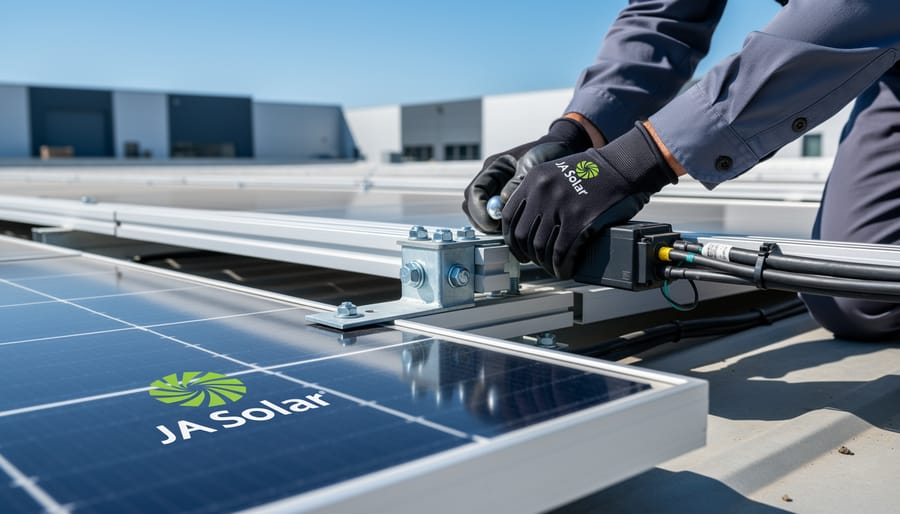
JA Solar modules consistently deliver efficiency ratings between 20.5% and 22.5% across their residential and commercial lines, with their latest TOPCon and N-type technologies pushing beyond 22% in 2026. This places them solidly in the high-performance tier, comparable to other top-tier manufacturers when evaluating JA Solar vs Trina or competing brands. Annual degradation rates typically run at 0.45% to 0.55% after first-year stabilization, meaning a module producing 400W initially will still deliver roughly 90% of its original output after 25 years, well within industry standards for bankable projects.
Temperature coefficients matter in hot climates. JA Solar’s monocrystalline modules typically show power loss coefficients around -0.35% to -0.37% per degree Celsius above 25°C. In practical terms, a rooftop installation in Arizona experiences less output drop on scorching afternoons compared to modules with higher coefficients, translating to better annual energy yield where it counts.
Warranty coverage follows industry norms but with competitive terms. JA Solar offers a 12-year product warranty covering manufacturing defects and a 25-year linear performance warranty guaranteeing at least 84.8% of rated power at year 25. Some premium series extend the product warranty to 15 years. These terms provide financial protection and signal the manufacturer’s confidence in long-term durability.
Third-party validation backs these claims. JA Solar modules carry IEC 61215 and IEC 61730 certifications for safety and performance, plus UL listing for the North American market. The company appears on Bloomberg NEF’s Tier 1 list, a key bankability indicator that institutional investors and large-scale developers use when assessing project risk. Independent testing from organizations like TÜV and DNV GL confirms that JA Solar modules withstand salt mist, ammonia exposure, and extreme mechanical loads, making them suitable for agricultural, coastal, and industrial environments where reliability under stress defines real-world value.
Frequently Asked Questions About JA Solar Modules
Where are JA Solar modules manufactured?
JA Solar produces modules primarily in China, with manufacturing facilities in Malaysia, Vietnam, and other locations to serve global markets. The company operates one of the largest integrated solar supply chains, controlling production from silicon wafers through finished modules.
How do JA Solar modules compare to other top brands?
JA Solar modules typically rank among the top tier for efficiency and reliability, competing directly with brands like Trina Solar, Longi, and Canadian Solar. They often deliver comparable performance at a slightly lower price point, making them attractive for cost-conscious projects without sacrificing quality.
Are JA Solar modules suitable for residential installations?
Yes, JA Solar’s DeepBlue series is specifically designed for residential rooftops, offering high efficiency in compact footprints. These modules work well with standard residential mounting systems and deliver strong performance in varied climate conditions.
What is the typical lifespan of JA Solar modules?
JA Solar modules are designed for 25 to 30 years of operational life, with performance warranties typically guaranteeing at least 80-84% of original output after 25 years. Under proper conditions, many modules continue generating electricity well beyond their warranty period.
Pricing for JA Solar modules varies based on the specific series, order volume, and market conditions, but they generally position in the competitive mid-range bracket. Residential modules typically range from $0.50 to $0.75 per watt at wholesale, while utility-scale orders can achieve lower per-watt costs through volume discounts. Actual installed system prices depend heavily on labor, permitting, and balance-of-system components rather than module cost alone.
Regarding U.S. incentives and tariffs, eligibility shifts as policy evolves. JA Solar modules manufactured in Southeast Asian facilities may qualify for certain tariff exemptions or reduced rates compared to China-produced panels, though specific treatment depends on current trade policy. These modules are generally compatible with federal Investment Tax Credit (ITC) and state-level incentive programs, provided they meet local content requirements where applicable. Installers and project developers should verify current tariff status and certification requirements with customs brokers or trade attorneys, as these rules change periodically and can significantly impact project economics.
JA Solar modules have earned their place among the world’s leading solar panel options through a consistent focus on manufacturing excellence, technological innovation, and bankable performance. With production scale that places them among the industry’s top manufacturers, JA Solar delivers photovoltaic modules that meet the demands of residential homeowners, commercial property managers, and utility-scale project developers alike.
The company’s embrace of PERC technology, half-cut cell designs, bifacial architectures, and emerging N-type platforms reflects a broader shift in the solar industry toward higher efficiency and lower levelized costs. These innovations translate directly into more electricity generated per square meter, better performance in challenging conditions, and improved returns on investment over the 25-plus-year lifespan of a solar installation.
What sets JA Solar apart is not any single breakthrough, but rather the combination of proven reliability, competitive pricing, and continuous incremental improvement across their product lineup. Whether you’re considering the DeepBlue series for a rooftop array or the JAM series for a ground-mounted solar farm, JA Solar modules offer a pragmatic balance of performance and value backed by robust warranties and global certifications.
As solar technology continues to advance and costs decline, the choice of module becomes increasingly important to project success. If JA Solar modules align with your system design requirements, budget, and performance expectations, they represent a credible option worth serious consideration. Work with certified solar installers who can evaluate your specific site conditions, energy goals, and local incentives to determine whether JA Solar is the right fit for your 2026 solar project.